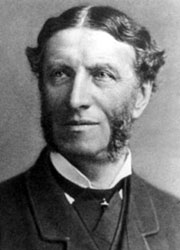
Empedocles on Etna
[Last Song of Callicles]
Through the black, rushing smoke-bursts,
Thick breaks the red flame;
All Etna heaves fiercely
Her forest-clothed frame.
Not here, O Apollo!
Are haunts meet for thee.
But, where Helicon breaks down
In cliff to the sea,
Where the moon-silvered inlets
Send far their light voice
Up the still vale of Thisbe,
O speed, and rejoice!
On the sward at the cliff-top
Lie strewn the white flocks;
On the cliff-side the pigeons
Roost deep in the rocks.
In the moonlight the shepherds,
Soft lulled by the rills,
Lie wrapped in their blankets,
Asleep on the hills.--
What forms are these coming
So white through the gloom?
What garments outglistening
The gold-flowered broom?
What sweet-breathing presence
Outperfumes the thyme?
What voices enrapture
The night's balmy prime?--
'Tis Apollo comes leading
His choir, the Nine.--
The leader is fairest,
But all are divine.
They are lost in the hollows!
They stream up again!
What seeks on this mountain
The glorified train?--
They bathe on the mountain,
In the spring by their road;
Then on to Olympus,
Their endless abode!--
Whose praise do they mention?
Of what is it told?--
What will be forever;
What was from of old.
First hymn they the Father
Of all things--and then,
The rest of immortals,
The action of men.
The day in his hotness,
The strife with the palm;
The night in her silence,
The stars in their calm.
1852
Self-Dependence
Weary of myself, and sick of asking
What I am, and what I ought to be,
At the vessel's prow I stand, which bears me
Forwards, forwards, o'er the starlit sea.
And a look of passionate desire
O'er the sea and to the stars I send:
"Ye who from my childhood up have calmed me,
Calm me, ah, compose me to the end.
"Ah, once more," I cried, "ye stars, ye waters,
On my heart you mighty charm renew;
Still, still let me, as I gaze upon you,
Feel my soul becoming vast like you!"
From the intense, clear, star-sown vault of heaven,
Over the lit sea's unquiet way,
In the rustling night-air came the answer:
"Wouldst thou be as these are? Live as they.
"Unaffrightened by the silence round them,
Undistracted by the sights they see,
These demand not that the things without them
Yield them love, amusement, sympathy.
"And with joy the stars perform their shining,
And the sea its long moon-silvered roll;
For self-poised they live, nor pine with noting
All the fever of some differing soul.
"Bounded by themselves, and unregardful
In what state God's other works may be,
In their own tasks all their powers pouring,
These attain the mighty life you see."
O air-born voice! long since, severely clear,
A cry like thine in my own heart I hear:
"Resolve to be thyself; and know that he
Who finds himself loses his misery!"
1852
The Buried Life
Light flows our war of mocking words, and yet,
Behold, with tears mine eyes are wet!
I feel a nameless sadness o'er me roll.
Yes, yes, we know that we can jest,
We know, we know that we can smile!
But there's a something in this breast,
To which thy light words bring no rest,
And thy gay smiles no anodyne.
Give me thy hand, and hush awhile,
And turn those limpid eyes on mine,
And let me read there, love! thy inmost soul.
Alas! is even love too weak
To unlock the heart, and let it speak?
Are even lovers powerless to reveal
To one another what indeed they feel?
I knew the mass of men concealed
Their thoughts, for fear that if revealed
They would by other men be met
With blank indifference, or with blame reproved;
I knew they lived and moved
Tricked in disguises, alien to the rest
Of men, and alien to themselves--and yet
The same heart beats in every human breast!
But we, my love!--doth a like spell benumb
Our hearts, our voices?--must we too be dumb?
Ah! well for us, if even we,
Even for a moment, can get free
Our heart, and have our lips unchained;
For that which seals them hath been deep-ordained!
Fate, which foresaw
How frivolous a baby man would be--
By what distractions he would be possessed,
How he would pour himself in every strife,
And well-nigh change his own identity--
That it might keep from his capricious play
His genuine self, and force him to obey
Even in his own despite his being's law,
Bade through the deep recesses of our breast
The unregarded river of our life
Pursue with indiscernible flow its way;
And that we should not see
The buried stream, and seem to be
Eddying at large in blind uncertainty,
Though driving on with it eternally.
But often, in the world's most crowded streets,
But often, in the din of strife,
There rises an unspeakable desire
After the knowledge of our buried life;
A thirst to spend our fire and restless force
In tracking our true, original course;
A longing to inquire
Into the mystery of this heart which beats
So wild, so deep in us--to know
Whence our lives come and where they go.
And many a man in his own breast then delves,
But deep enough, alas! none ever mines.
And we have been on many thousand lines,
And we have shown, on each, spirit and power;
But hardly have we, for one little hour,
Been on our own line, have we been ourselves--
Hardly had skill to utter one of all
The nameless feelings that course through our breast,
But they course on forever unexpressed.
And long we try in vain to speak and act
Our hidden self, and what we say and do
Is eloquent, is well--but 'tis not true!
And then we will no more be racked
With inward striving, and demand
Of all the thousand nothings of the hour
Their stupefying power;
Ah yes, and they benumb us at our call!
Yet still, from time to time, vague and forlorn,
From the soul's subterranean depth unborne
As from an infinitely distant land,
Come airs, and floating echoes, and convey
A melancholy into all our day.
Only--but this is rare--
When a beloved hand is laid to ours,
When, jaded with the rush and glare
Of the interminable hours,
Our eyes can in another's eyes read clear,
When our world-deafened ear
Is by the tones of a loved voice caressed--
A bolt is shot back somewhere in our breast,
And a lost pulse of feeling stirs again.
The eye sinks inward, and the heart lies plain,
And what we mean, we say, and what we would, we know.
A man becomes aware of his life's flow,
And hears its winding murmur; and he sees
The meadows where it glides, the sun, the breeze.
And there arrives a lull in the hot race
Wherein he doth forever chase
That flying and elusive shadow, rest.
An air of coolness plays upon his face,
And an unwonted calm pervades his breast.
And then he thinks he knows
The hills where his life rose,
And the sea where it goes.
1852
------------------------------------------------------------------------------------------------------------------------------------------------
The Scholar Gypsy
------------------------------------------------------------------------For early didst thou leave the world, with powers
Fresh, undiverted to the world without,
Firm to their mark, not spent on other things;
Free from the sick fatigue, the languid doubt,
Which much to have tried, in much been baffled, brings.
O life unlike to ours!
Who fluctuate idly without term or scope,
Of whom each strives, nor knows for what he strives,
And each half lives a hundred different lives;
Who wait like thee, but not, like thee, in hope.
Thou waitest for the spark from heaven! and we,
Light half-believers of our casual creeds,
Who never deeply felt, nor clearly willed,
Whose vague resolves never have been fulfilled;
For whom each year we see
Breeds new beginnings, disappointments new;
Who hesitate and falter life away,
And lose tomorrow the ground won today.
1853
------------------------------------------------------------------------------------------------------------------------------------------------Passage from Joseph Glanvill's Vanity of Dogmatizing (1661), included by Arnold as a note to "The Scholar Gypsy": "There was very lately a lad in the University of Oxford, who was by his poverty forced to leave his studies there; and at last to join himself to a company of vagabond gypsies. Among these extravagant people, by the insinuating subtilty of his carriage, he quickly got so much of their love and esteem as that they discovered him to their him to their mystery. After he had been a pretty while exercised in the trade, there chanced to ride by a couple of scholars, who had formerly been of his acquaintance. They quickly spied out their old friend among the gypsies; and he gave them an account of the necessity which drove him to that kind of life, and told them that the people he went with were not such imposters as they were taken for, but that they had a traditional kind of learning among them, and could do wonders by the power of imagination, their fancy binding that of others: that himself had learned much of their art, and when he had compassed the whole secret, he intended, he said, to leave their company, and give the world an account of what he had learned."
The tone of the poem elegiac. In a letter to Clough Arnold condemned it for failing to 'animate': "The Gipsy scholar at best awakens a pleasing melancholy. But this is not what we want."
Dover Beach
The sea is calm tonight.
The tide is full, the moon lies fair
Upon the straits--on the French coast the light
Gleams and is gone; the cliffs of England stand,
Glimmering and vast, out in the tranquil bay.
Come to the window, sweet is the night air!
Only, from the long line of spray
Where the sea meets the moon-blanched land,
Listen! you hear the grating roar
Of pebbles which the waves draw back, and fling,
At their return, up the high strand,
Begin, and cease, and then again begin,
With tremulous cadence slow, and bring
The eternal note of sadness in.
Sophocles long ago
Heard it on the Aegean, and it brought
Into his mind the turbid ebb and flow
Of human misery; we
Find also in the sound a thought,
Hearing it by this distant northern sea.
The Sea of Faith
Was once, too, at the full, and round earth's shore
Lay like the folds of a bright girdle furled.
But now I only hear
Its melancholy, long, withdrawing roar,
Retreating, to the breath
Of the night wind, down the vast edges drear
And naked shingles of the world.
Ah, love, let us be true
To one another! for the world, which seems
To lie before us like a land of dreams,
So various, so beautiful, so new,
Hath really neither joy, nor love, nor light,
Nor certitude, nor peace, nor help for pain;
And we are here as on a darkling plain
Swept with confused alarms of struggle and flight,
Where ignorant armies clash by night.
1867
only the two left
even the world, without faith, desolate
amplification of romantic love over love of God
necessary dependence on it
Culture and Anarchy
Sweetness and Light
"Culture is...properly described not as having its origin in curiosity, but as having its origin in the love of perfection; it is a study of perfection. It moves by the force, not merely or primarily of the scientific passion for pure knowledge, but also of the moral and social passion for doing good."
"As I have said on a former occasion: 'It is in making endless additions to itself, in the endless expansion of its powers, in endless growth in wisdom and beauty, that the spirit of the human race finds its ideal. To reach this ideal, culture is an indispensable aid, and that is the true value of culture.' Not a having and a reating, but a growing and a becoming, is the character of perfection as culture conceives it; and here, too, it coincides with religion."
"...perfection...is a harmonious expansion of all the powers which make the beauty and worth of human nature..."
"...culture...a study of perfection, and of harmonious perfection, general perfection, and perfection which consists in becoming something rather than in having something, in an inward condition of the mind and spirit, not in an outward set of circumstances..."
"...the necessary first stage to a harmonious perfection...the subduing of the great obvious faults of our animality..."
"Oxford, the Oxford of the past, has many faults; and she has heavily paid for them in defeat, in isolation, in want of hold upon the modern world. yet we in Oxford, brought up amidst the beauty and sweetness of that beautiful place, have not failed to seize one truth:--the truth that beauty and sweetness are essential characters of a complete human perfection."
"...by alternations of Hebraism and Hellenism, of a man's intellectual and moral impulses, of the effort to see things as they really are, and the effort to win peace by self-conquest, the human spirit proceeds; and each of these two forces has its appointed hours of culmination and seasons of rule."