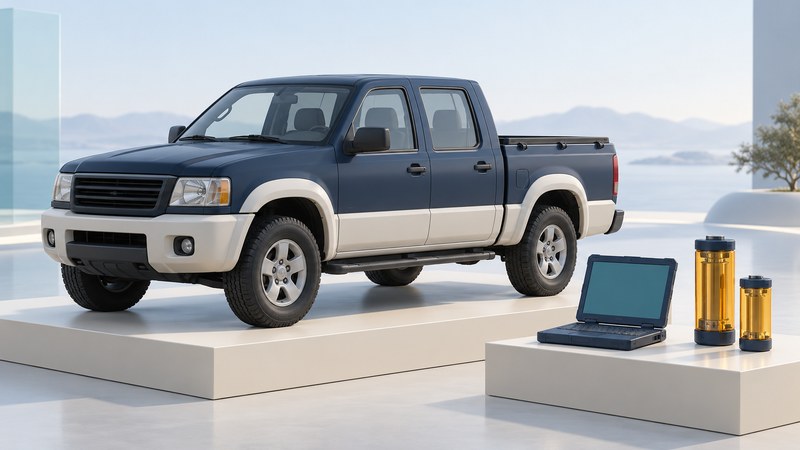
Smart Truck 3, named SmarTruck III in the contemporary records, was a 2004 vehicle demonstrator joining a commercial truck platform with military technology concepts. Its value as a historical case lies in the integration questions it raised: how to combine communications, observation, vehicle diagnostics and energy recovery in one usable vehicle.
The concept unveiled in Detroit
International Truck and Engine’s March 8, 2004 launch release (PDF) introduced SmarTruck III and the International Commercial Utility Vehicle at the SAE World Congress. It described a four-wheel-drive medium-truck platform and a collaboration with the Army’s National Automotive Center.
The release proposed military and commercial uses, location reporting, remote diagnostics and a 4.5-liter V6 diesel with hydraulic launch assist. Its fuel-economy and protection statements expressed the developers’ aims and claims; the release supplied neither a comparative fuel-test report nor a complete protection-test record.
The distinction matters when looking back at a demonstrator. A physical vehicle can bring several technologies together and still require extensive work before procurement, training, maintenance support and routine service.
What a connected truck was meant to add
Army Logistician’s November–December 2004 account, printed page 52 (PDF), identifies Integrated Concepts and Research Corporation and Heart International as builders working with International for the National Automotive Center. It describes cameras, communications equipment and vehicle diagnostics—and states that the Army had set no fielding date.
Telematics joins vehicle information to communications. Location data helps answer where a truck was observed; diagnostics describe reported vehicle condition. The useful result depends on the observation time, connection availability, data meaning and the person responsible for acting on it.
That example explains the promise of remote diagnostics without assuming that a particular 2004 subsystem delivered it reliably. The broader guide to vehicle-electronics integration covers power, interfaces and crew usability.
How hydraulic launch assist fits the idea
Hydraulic energy recovery stores some braking energy for a later acceleration. In the EPA’s explanation of a parallel hydraulic hybrid, the conventional drivetrain remains in place. A pump/motor moves fluid into an accumulator during braking and uses stored energy to help turn the drivetrain during acceleration.
The EPA’s accumulator explanation describes hydraulic fluid compressing nitrogen gas. The stored energy can then be released through the hydraulic system. These sources explain the general principle, rather than the detailed installed configuration of SmarTruck III.
To assess a fuel-saving claim, ask about the driving cycle. Frequent braking and acceleration create different opportunities from steady cruising. Payload, route, speed, idle time and measurement method belong beside the fuel figure. A percentage without those conditions is difficult to transfer to another vehicle or task.
Separate the milestones
On a narrow screen, focus this table and use the arrow keys to scroll.
| Milestone | What it establishes | Useful next evidence |
|---|---|---|
| Concept unveiled | A proposed combination of technologies was presented. | Configuration and demonstration records. |
| Test completed | A stated configuration was exercised under particular conditions. | Method, results, comparison baseline and unresolved issues. |
| Production contracted | An identified buyer ordered defined work. | Quantities, delivery records and acceptance scope. |
| Fielded and supported | Users received a configuration with an operating and support arrangement. | Dated service records, training and maintenance evidence. |
The cited 2004 records support a demonstrator history. They leave later production and fielding to be established by further records. An absence of a fielding date in 2004 also leaves the eventual outcome open; it does not establish a later cancellation.
Use the concept-vehicle evidence record (TXT) to keep a claim, its dated source and its remaining questions together. Compare vehicle families separately in Military Trucks: Roles, Payload, and Vehicle Specifications.