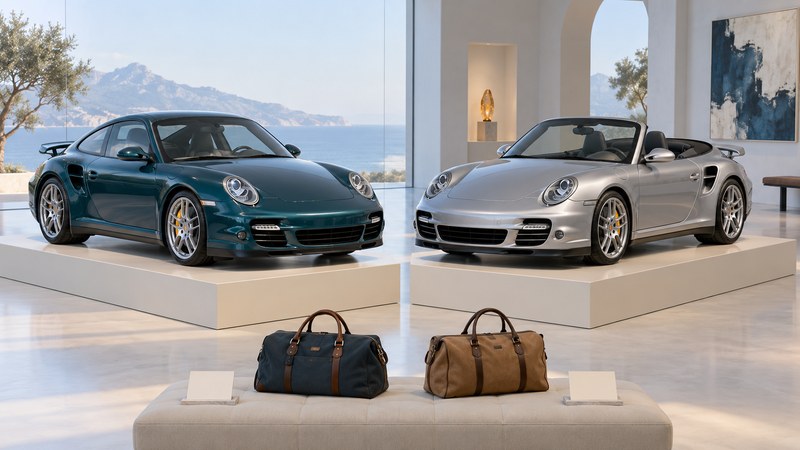
Choosing a 2008 Porsche 911 Turbo Cabriolet means deciding how much open-roof driving matters in the journeys you actually take. Compare it with a same-era Turbo coupe using the transmission you want, documented equipment, body-specific condition and realistic passenger and luggage needs.
Start with the exact generation. This guide concerns the US 2008, first-phase 997 Turbo Cabriolet. Its identity and body construction provide a clear boundary for the comparison.
Identify the 3.6-liter Turbo Cabriolet
Porsche's US 2008 Turbo Cabriolet press dossier, preserved by Rennkit, specifies the 3.6-liter twin-turbo flat-six, all-wheel drive, a standard six-speed manual and optional five-speed Tiptronic S. Its matching specification sheet separates the two transmissions.
Porsche's Turbo-generation history places the 3.8-liter engine and optional seven-speed PDK in the later 2010 model update. Keep that revision separate from the 2008 car. Record model year, market, build identity and transmission before comparing advertisements.
The 997 Turbo technology guide explains variable turbine geometry and period performance claims. Here, the central question is how the Cabriolet's body and equipment fit your ownership plan.
Understand what changes with the open roof
The 2008 press dossier describes a fabric folding roof, reinforced windshield structure and automatically deploying rear rollover protection. It reports the manual Cabriolet as 155 pounds heavier than the corresponding manual coupe. That is a period like-for-like manufacturer comparison, with transmission held constant.
Porsche also describes Cabriolet-specific rear-spoiler extension and suspension details. Body style therefore reaches beyond the roof itself. Use the relevant body-specific parts and service information when reviewing repairs or modifications.
Ask the seller to demonstrate the roof while stationary, following the car's matching handbook and with clear space around the mechanism. Have a specialist assess the roof, seals, operating mechanisms and evidence of water entry or body repair. Keep observations about appearance, operation and underlying condition in separate lines.
Compare two actual candidates
On a narrow screen, scroll the table sideways. Keyboard users can focus the table region and use the arrow keys.
| Decision | What to compare | Evidence to keep |
|---|---|---|
| Transmission preference | Same-era manual against manual, or Tiptronic S against Tiptronic S. | Car identity, original specification and inspection findings. |
| Open-air use | How often the planned route, weather and passengers make roof-down travel useful. | A realistic journey scenario and permitted demonstration. |
| Body condition | Coupe body and glazing versus Cabriolet roof, seals, mechanisms and body structure. | Body-specific specialist report and repair records. |
| Equipment | Installed brakes, seats, Sport Chrono and other desired options. | Build information, fitted components and demonstrated functions. |
| Everyday fit | Seat access, actual bags, parking and roof-up comfort. | Viewing notes with the same people and luggage needs. |
For the 2008 Cabriolet, Porsche lists ceramic composite brakes and Sport Chrono Package Turbo among the options. Confirm what is fitted and have the appropriate components assessed. A generic Turbo specification leaves those choices unresolved.
Try the car with the roof closed as well as open. The closed-roof journey includes visibility, cabin sound and climate comfort; the open-roof journey adds wind exposure and storage questions for removable accessories. Use the matching handbook to establish seating and accessory restrictions.
Example: occasional touring or frequent open-air trips
Fictional comparison: two buyers inspect a manual coupe and a manual Cabriolet. One expects mostly cold-weather motorway travel and prioritizes a simple routine. The other plans frequent fair-weather touring and values the open cabin. Both use the same luggage trial and commission the appropriate specialist inspections.
If the Cabriolet has incomplete roof-repair records, the useful next step is to resolve that history and obtain a condition assessment. The buyers can then compare their desired experience with identified work and current quotations. An attractive roof-down photograph supplies only one part of the decision.
Write essential requirements before ranking the cars: preferred gearbox, acceptable access, useful bag space, documented condition and service support. Keep optional preferences in a second list. This makes a tradeoff visible when one candidate meets the practical requirements more convincingly.
Keep the body-style comparison
Download the Turbo Cabriolet comparison record. Use one sheet for each candidate and retain the market and transmission labels on every specification. For a separate 997 open-top family, see the Carrera 4 and 4S Cabriolet guide; use Turbo-specific evidence for this decision.
Explore Autos: vehicle guides, technology and design · Cars: buying, maintenance and ownership