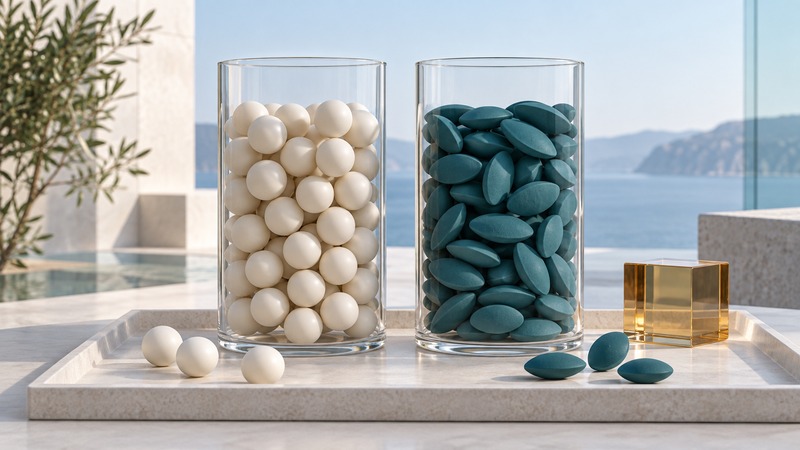
Packing fraction is the share of a bulk volume occupied by the particles themselves. The rest is space between them. Measuring it well requires both a particle-volume estimate and a clearly defined way to fill the container. Shape matters, but so do size distribution, walls and how the particles are poured or settled.
This guide is for students and readers interested in granular materials. The classic experiment using chocolate candies provides a memorable starting point; a simple measurement exercise shows how to make the comparison checkable.
Define the two volumes
Use packing fraction φ = total particle volume ÷ bulk occupied volume. For solid, nonporous particles, the interparticle void fraction is 1 − φ. The bulk volume includes the gaps inside the filled region. Measure to the chosen fill surface rather than automatically using the container's full capacity.
Counting particles works when their individual volumes are known adequately. For equal spheres of diameter d, each volume is πd³/6. Another approach uses sample mass divided by a suitable material density. State whether that density describes the solid material or includes pores within particles; the choice changes which “empty space” the calculation counts.
What the candy experiment showed
In their 2004 Science study, Donev and colleagues compared jammed disordered packings of spheres and ellipsoidal shapes. Their round-flask experiments gave a packing fraction of about 0.685 for the candies and 0.635 for the spherical ball bearings, with reported uncertainties of about 0.01. Simulations explored a wider range of ellipsoid shapes.
The study is useful because it tied a surprising result to a measurement procedure and model. A flattened or elongated particle has orientation as well as position, changing how it can move and become mechanically constrained. Subsequent research on jammed nonspherical particles examined those constraints and contacts in more detail.
The roughly 0.74 density associated with the densest ordered arrangements of equal spheres is a different comparison from a randomly prepared jammed sample. Keep the shape, order and preparation method attached to every packing number. The 2004 paper explicitly discusses why a single universal “random close packing” value is an inadequate description of all protocols.
Make a comparison you can repeat
For a classroom comparison, choose intact particles whose volumes can be estimated reliably and a container with a measurable internal volume. Use sufficiently many particles to reduce the dominance of the walls, and record the container dimensions relative to particle size. A narrow vessel can encourage arrangements that differ from those in a larger bulk sample.
- Define the comparison: for example, compare two shapes using a fixed solid volume of particles in the same container.
- Document the particles: record shape, dimensions, size spread and the method used to estimate total particle volume.
- Fix a filling rule: specify pouring conditions and whether settling or tapping is included.
- Measure the filled region: use a consistent rule for an uneven upper surface.
- Empty and refill independently: repeat the whole preparation, not just the reading of one unchanged sample.
- Report individual results: compare variation as well as the average.
A changed tapping procedure is a new experimental condition. Record it explicitly rather than combining the resulting measurements as though they came from one method.
Interpret variation before explaining it
On a narrow screen, focus this table and use the arrow keys to scroll.
| Independent fill | Bulk volume | Packing fraction |
|---|---|---|
| 1 | 80.0 cm³ | 0.6545 |
| 2 | 82.0 cm³ | 0.6385 |
| 3 | 81.0 cm³ | 0.6464 |
These invented results differ despite using the same particle volume. The mean of the three fractions is about 0.6465. Before attributing a similar difference between two real samples entirely to shape, examine the size spread, fill rule and variation across repeats. Report both the measurement method and what was held constant.
Download the packing measurement sheet for a standalone procedure, the sphere calculation and a repeat-record template. It helps keep assumptions visible when comparing a classroom measurement with a published result.
Dense packing can matter for powders and ceramic processing, but performance also depends on particle chemistry, friction, porosity and subsequent processing. A measured packing fraction answers a geometric question. Use additional evidence to connect it to strength, flow or the behavior of a finished material.
Related science guides
Explore all science guides. Sources reviewed September 11, 2026.