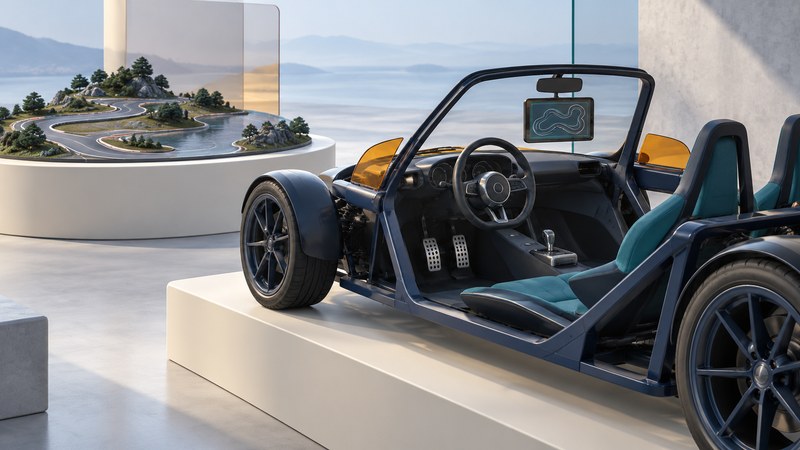
Nissan URGE is a useful case study in giving familiar controls a second purpose. Its steering wheel and pedals could become inputs for a racing game while the concept car was parked. The interesting design question is how a person knows which system those controls are operating.
What Nissan proposed for 2006
Created by Nissan Design America, the open, motorcycle-inspired URGE appeared in the 2006 Detroit concept-car program. Nissan described an exposed aluminum structure, two main seats and an additional rear seat. Its gaming feature paired an Xbox 360 with a special Project Gotham Racing 3 demonstration. A screen folded down from the mirror area, and the vehicle speakers supplied sound. These are manufacturer descriptions of a concept, rather than specifications for a retail gaming accessory. See Nissan’s detailed URGE account.
The partner announcement explicitly placed gaming in the parked vehicle and described the steering wheel, accelerator and brake as game inputs. That operating condition belongs in any retelling of the feature. See Microsoft’s December 2005 announcement.
Read the interface as two modes
The table below is an analytical framework. It separates the intended meaning of a control from the evidence needed to confirm its behavior. The physical resemblance to driving makes the idea understandable, but also makes mode recognition central to the experience.
On a narrow screen, scroll the table sideways. Keyboard users can focus the table region and use the arrow keys.
| Element | Gaming role described | Question for an interface review |
|---|---|---|
| Steering wheel | Direction input in the racing game | What confirms that this input is assigned to the game? |
| Pedals | Acceleration and braking in the game | What prevents an ambiguous transition between modes? |
| Fold-down display | View of the virtual race | How does its position communicate the active mode? |
| Vehicle speakers | Game audio | Which sounds identify game events and system status? |
For example, a reviewer could document the same pedal movement in each mode, then record the feedback the user receives. That would test consistency of meaning. A photograph of someone holding the wheel would establish much less: it could show the arrangement without showing the system state.
The transition deserves its own evidence
Nissan said the driver disengaged driving controls before activating the game. Its account does not establish a detailed interlock design or provide a validation report. Keep that distinction clear when discussing how the demonstration worked.
- Entering: record the required vehicle state, the action that selects gaming and the confirmation shown to the user.
- Playing: identify which controls are active, what each controls and whether the active mode remains apparent.
- Leaving: document how the game ends and how the interface confirms the next state.
These are proposed review questions, not instructions for modifying a car. They also provide a useful way to examine other multifunction interfaces: a button’s shape may stay constant while its meaning changes. The transition and feedback should be included in the account alongside the visible hardware.
What this concept can teach
URGE made the connection between a driving game and a physical cockpit unusually direct. That is a design interpretation supported by the described control mapping. Claims about ease of use, reliability or driver behavior would require observations beyond the launch materials. A good concept study can explain the idea clearly while leaving those outcomes open.
Build a compact interface record
Download the URGE interface concept record. Use one line for the source’s claim, one for your interpretation and one for the next observation needed. For an automotive game built around marketing rather than shared physical controls, compare the BMW X3 campaign study.
Explore Autos: vehicle guides, technology and design · Cars: buying, maintenance and ownership