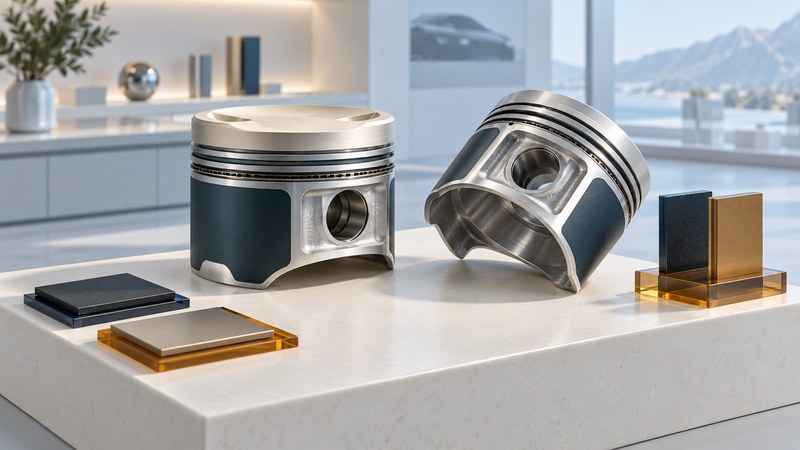
Choose a piston coating by the surface and failure mechanism it must address. A crown thermal barrier, a ring-groove treatment and a skirt friction coating serve different purposes. A useful proposal identifies the substrate, coating system, finished dimensions and evidence from the intended engine duty.
Start with the location and duty
Record the piston alloy and design, operating duty, lubrication, mating surfaces and the observed problem. Ask whether the target is heat flow, groove wear, scuffing or another documented failure. “Ceramic” describes a broad material family; it supplies too little information to select a treatment.
MAHLE's piston overview distinguishes treatments used on different piston regions. Its examples are product-specific. Obtain the piston and coating suppliers' approval for the exact combination before changing surface preparation, thickness or final dimensions.
On narrow screens, scroll the table horizontally. Keyboard users can focus it and use the arrow keys.
| Region | Intended function to define | Evidence to request |
|---|---|---|
| Crown | Control heat transfer or protect a combustion-facing surface | Coating/substrate compatibility, thermal cycling, adhesion and engine measurements. |
| Ring grooves | Maintain the specified groove and ring contact behavior | Wear evidence, dimensional inspection and compatibility with the actual ring package. |
| Skirt | Manage friction, scuffing and bore contact | Lubricated wear testing, finished profile and clearance instructions for the exact piston. |
Evaluate the complete coating system
A coating specification should name the material, deposition process, preparation, bond layer where used, thickness range, masked regions and inspection method. Include how the supplier checks adhesion and defects, and how it handles a rejected or reworked part. Surface dimensions after coating affect fit; follow the applicable drawing and installation instructions.
A 1995 NASA Tech Brief on combined thermal-barrier and wear coatings describes a combustion-chamber coating concept and emphasizes compatible layers, adhesion and thermal expansion. It is historical evidence for evaluating a coating system, not qualification of a present-day piston product.
Separate coupon results from engine results
Ask for repeated specimens and the spread of results. A single favorable coupon can justify further investigation, while an engine claim needs an engine test with a matched reference, controlled conditions and defined endpoints. Inspect where damage occurs: coating wear, delamination and substrate cracking call for different corrective actions.
Write an application-specific decision
Make the proposed benefit measurable. Define the engine configuration, baseline, test duty, inspection intervals and stop criteria with the responsible engineering team. Record heat-flow or temperature measurement locations, friction or wear measurements, and the condition of mating parts where relevant.
Accept only the scope supported by the evidence. Keep claimed improvements, demonstrated results and unresolved questions separate in the working record. For broader preparation and qualification questions, see coating-process selection and qualification; the material and engine-specific requirements still come from the applicable suppliers and engineering plan.
Use the working record
Download the editable working record. It includes the task-specific fields, instructions, fictional example and source references needed to preserve the evidence behind a decision. Complete it with the people responsible for the actual process.