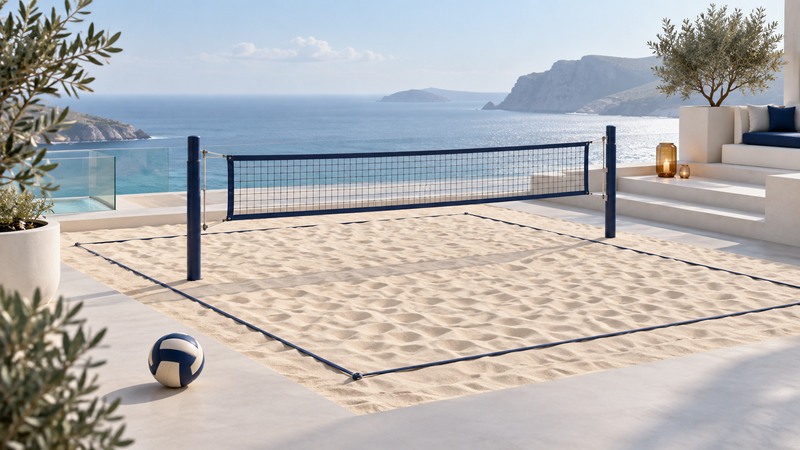
Beach volleyball pairs two players on each side of a sand court. Every rally can change the score, and each player must help receive, set, attack and defend. Follow the scoreboard first, then the serve target and the space the attackers try to reach.
Know what ends a set
Under the FIVB 2025–2028 rules, the first two sets are played to 21 points and a deciding third set to 15. Each needs a two-point lead. Winning two sets wins the match. A rally winner earns a point; a receiving team that wins also takes the serve. The court measures 16 × 8 metres; the senior net height is 2.43 metres for men and 2.24 for women. See rules 1, 2 and 6.
Watch the set number as well as the large score digits. At 20–19 in either opening set, the next rally can finish the set. At 20–20, play continues until a pair gets two ahead. A scoreboard showing one set each makes every late third-set rally particularly consequential.
Count contacts and watch the decision
A team gets up to three contacts to return the ball, including a block touch. After that block, either player—including the blocker—may make the next contact. A ball touching a boundary line is in. These basics come from FIVB rules 8, 9 and 14.
Picture a fictional attack that brushes the defender’s block. The blocker then digs the rebound, and the partner sends it across: that uses all three contacts. Count the touch at the net before judging what looks like an ordinary pass-set-attack sequence.
The FIVB illustrated casebook helps interpret difficult ball-handling and net situations. Read the scenario and ruling together: whether a contact is a catch, a double contact or permitted defensive action depends on the action and applicable exception. Ball spin alone leaves out the contact the referee must judge.
When a whistle interrupts a rally, observe the referee’s signal and the awarded serve. A slow-motion replay may clarify the sequence, but its camera angle can hide a touch or the relationship between the ball and a boundary. Use the confirmed ruling to continue following the match.
Track service and the court switches
The same player continues serving while that pair keeps winning rallies. When the pair regains service later, its partner serves next. Teams switch ends after every seven total points in the first two sets and every five in the third; those are totals from both teams, not a lead. See FIVB rules 12 and 18.
For a recreational game, agree the local format before starting. Casual group games may use different team sizes or scoring. Those adaptations are fine for that game, but compare an Olympic match against its official two-player rules.
Watch one tactical question at a time
- Who receives? A repeated serve toward one player makes that player handle the first contact and often the eventual attack.
- Where is the setter forced to move? A pass close to its intended location gives more attacking options; a chase can make the return easier to anticipate.
- What space does the block cover? Watch how the backcourt defender positions around the blocker.
- Does the attacker choose power or placement? Follow the landing space, not just the swing speed.
These are viewing prompts, not a diagnosis of what a pair should have done. Wind, communication and the quality of the previous touch shape each choice. Compare several rallies before deciding that a repeated pattern is intentional.
Use a short tally on paper: serve target, quality of the first pass, attack direction and rally winner. After ten rallies, you will have a more concrete picture than a general impression that one team “looks stronger.” A small sample describes those rallies; it does not predict the whole tournament.
Rules basis checked September 11, 2026. Use the FIVB rules index for subsequent editions and the competition’s own regulations for its tournament progression.