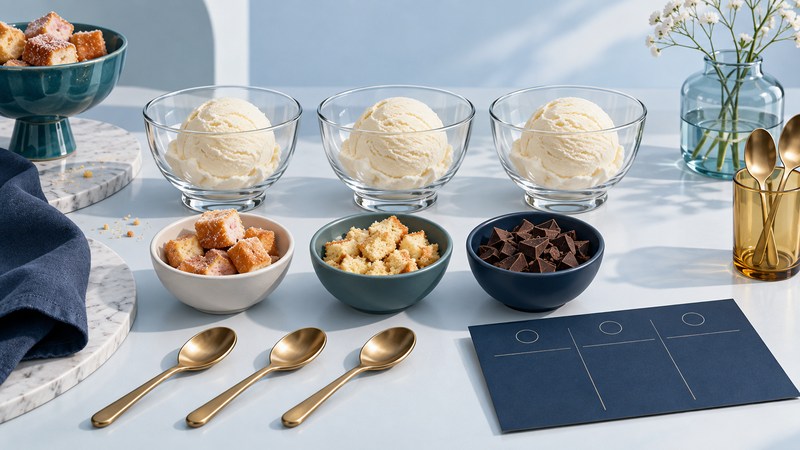
The Apprentice’s 2004 ice-cream challenge combined product development with selling. It is useful inspiration for a small home tasting, provided the two questions stay separate: which sample people prefer, and which product sells best in a particular setting.
What the television challenge involved
NBC’s September 13, 2004 announcement, preserved by The Futon Critic, promoted a September 16 episode in which candidates would create and sell gelato with Ciao Bella. A contemporary September 17 recap by Dayana Yochim describes the competing teams’ flavor-development and street-selling task.
Yenra’s coverage at the time recorded doughnut-themed and red-velvet-themed products. Those historical products are not the recipes below. The following exercise uses ready-made vanilla ice cream and measured baked goods to investigate a narrower question: how does a mix-in change the eating experience?
Set up three samples for four tasters
Original tasting exercise; no claim to reproduce Ciao Bella’s formulas. Use a kitchen scale, three chilled bowls, four sets of small tasting dishes, clean spoons, water and the mix-in tasting sheet. Buy at least 360 g of one vanilla ice cream. Check all ice-cream and baked-good ingredient labels with the tasters before preparing the samples.
Swipe the table sideways, or focus it and use the arrow keys.
| Sample | Base | Addition |
|---|---|---|
| A: control | 120 g vanilla ice cream | None |
| B: doughnut | 120 g vanilla ice cream | 12 g plain glazed doughnut, cut into small pieces |
| C: cake | 120 g vanilla ice cream | 12 g unfrosted cake, cut into small pieces |
The mix-in ratio is 10 g per 100 g of base for B and C. Each taster receives one quarter of each batch: about 30 g of A and 33 g each of B and C. This keeps the base amount equal; it does not keep final sample weights equal. The purpose is to compare additions to the same base.
Taste, record, then change one thing
- Soften the three weighed portions just enough to fold. Fold the additions into B and C with the same number of gentle strokes; keep A plain. Avoid letting any bowl become liquid.
- Return the bowls to the freezer together until scoopable, then portion and serve them together. Keep the temperature and waiting time as similar as practical.
- Have a helper code the samples if you want to reduce name-based expectations. Vary which sample each person tastes first, and provide water between samples.
- Privately score sweetness balance, texture and overall liking from 1 to 5. Write one concrete observation before discussing preferences.
“Cake disappeared into the base” or “doughnut pieces were too chewy when cold” gives you a change to test. “Best” alone does not. Repeat only one adjustment, such as smaller pieces or 6 g rather than 12 g of mix-in, while keeping the base and serving method the same.
Four household tasters provide local preferences, not a market forecast. The television task’s sales outcome also involved location, selling and customer access. A careful tasting can improve a recipe idea without pretending to measure those business factors. For a different flavor addition, see fruit and caramel topping quantities.